
Multi-City Flights: How to Search, Compare, and Book Them
Plan a trip with several flight legs, compare multi-city, open-jaw, and separate-ticket options, and avoid connection surprises.
 Naveen KettererHead of Growth at Soar · 11 min read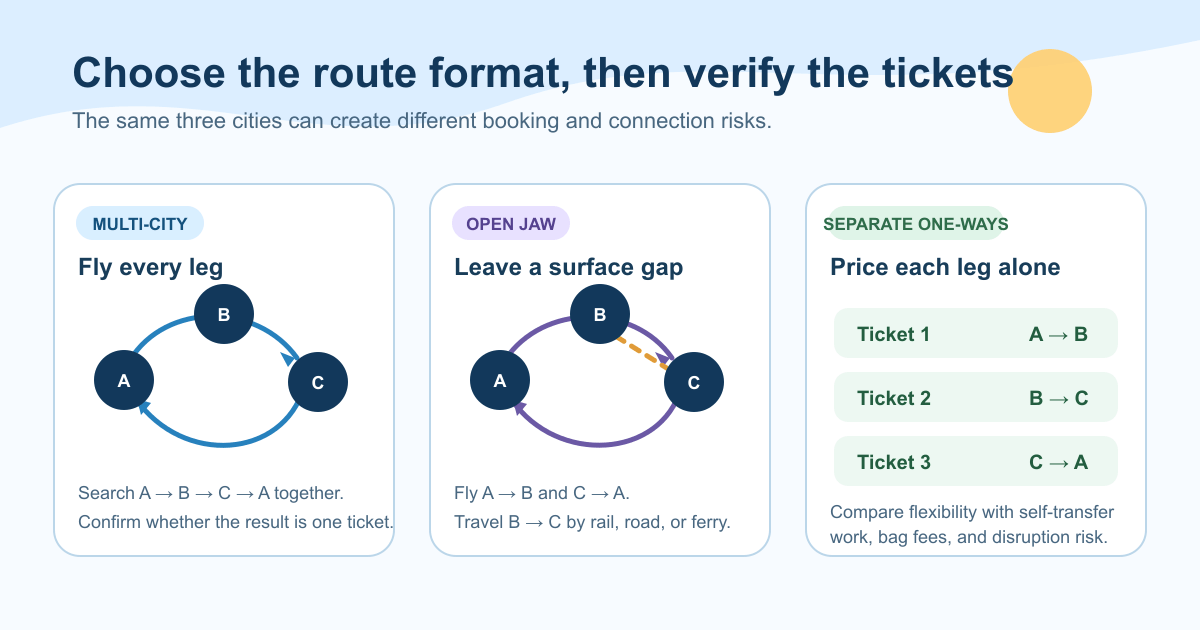
Multi-city flights let you search two or more flight legs in one itinerary, such as Los Angeles to London, London to Paris, and Paris to Los Angeles. They are useful when a trip does not fit a simple A → B → A round trip, but they are not automatically cheaper—or automatically issued as one protected ticket.
The practical answer is to search the complete route as a multi-city itinerary, then compare it with an open jaw and separate one-way tickets. Choose from the final totals only after checking the airports, schedule, bags, seller, ticket structure, change rules, and connection risk.
Quick decision: Fly every leg between A, B, and C? Start with multi-city. Travel overland between B and C? Start with an open jaw. Need different airlines or independently changeable dates? Compare separate one-ways.
What is a multi-city flight?
A multi-city flight is a search or booking with two or more distinct flight legs. Instead of asking only for Los Angeles to London and back, you can enter Los Angeles to London, London to Paris, and Paris to Los Angeles with a date for each leg.
The term describes the route format, not the legal or operational relationship between the flights. A result may be sold as one ticket, more than one ticket in a single checkout, or separate reservations. Read the booking details before assuming later flights are protected if an earlier one is delayed.
| Trip format | Route shape | Best fit | Main check |
|---|---|---|---|
| Round trip | A → B → A | One destination and the same home airport | Whether both directions fit your dates |
| One way | A → B | No return flight is needed yet | Cost and flexibility of the eventual onward trip |
| Open jaw | A → B, surface travel to C, C → A | A road or rail trip between two cities | Time and cost of the surface segment |
| Multi-city | A → B → C → A | Every city-to-city leg needs a flight | Whether the result uses one ticket or several |
Search sites do not always use these labels in exactly the same way. An open jaw is often entered through a Multi-city tab because the outbound destination and return origin differ. KAYAK's current multi-city guide and Skyscanner's multiple-destination search help both use a leg-by-leg form, but the booking structure still needs to be checked in the result.
When does a multi-city itinerary make sense?
Use a multi-city search when the flights themselves form a chain. Common examples include:
- a three-city trip with a flight between each stop;
- a work trip that continues to a vacation city before returning home;
- visiting family in two regions without backtracking to the first airport;
- starting from one home airport and returning to another; or
- combining a long-haul ticket with a separately planned regional leg.
The format can save time even when it does not lower the fare. Flying home from the last city may eliminate a hotel night, train ride, rental-car return, or day of backtracking. Put those avoided costs beside the airfare rather than judging the route from the flight price alone.
It can also simplify a trip when an airline or its partners can price every flight together. A single ticket may make baggage handling and disruption support easier, but the words “multi-city” do not prove that the result is a single ticket. Google's explanation of flight and booking options distinguishes airline interline itineraries from virtual interlines labeled as separate tickets booked together.
When are separate one-way tickets better?
Separate one-ways deserve a comparison when no airline or partnership serves the whole route well, when a regional low-cost carrier has a much better middle leg, or when one part of the trip may change independently.
The flexibility comes with separate responsibilities. You may need to check in again, pay baggage fees more than once, collect and recheck bags, pass through immigration or security, and leave a larger time buffer. If one reservation is disrupted, the airline on the next reservation may treat you as a no-show rather than rebook you.
Separate tickets make sense only when the saving justifies the added work and risk. Our Kiwi.com alternatives guide has a checklist for evaluating self-transfers.
Are multi-city flights cheaper?
Sometimes, but there is no dependable rule. A multi-city fare can be lower when the long-haul flights price like a return journey or when partner airlines can ticket the route together. It can be higher when one unusual leg narrows the available combinations, or when inexpensive local carriers are not part of the same fare.
The only useful test is a same-session comparison. Keep the dates, airports, passenger count, cabin, and baggage needs fixed, then record the complete purchasable total for each structure. Prices can move while you search, so capture the time and repeat any result that looks unexpectedly different.
Worked comparison: Los Angeles, London, and Paris
Suppose you want to leave Los Angeles on November 17, travel from London to Paris on November 21, and return from Paris on November 25. Keep one traveler, economy, and the exact airports fixed while comparing these three structures:
| Method | What you price | When it is the strongest candidate | What to verify |
|---|---|---|---|
| Multi-city | LAX → LHR, LHR → CDG, CDG → LAX in one search | You want to fly the middle leg and the complete itinerary prices well | Seller, ticket count, bags, and protection between legs |
| Open jaw | LAX → LHR and CDG → LAX, plus London → Paris rail | The train replaces an unnecessary airport day or flight | Airfare plus rail cost, station transfers, and luggage handling |
| Separate one-ways | The same three flights priced individually | Independent fares or schedules are meaningfully better | Three sets of rules, bag fees, and missed-connection exposure |
For this route, an open jaw is the baseline if you prefer the train; multi-city is the comparison if you want to fly the middle leg. Price all three methods in one session and record the final total, seller, bags, ticket count, and travel time. Separate one-ways should win only when their price or schedule advantage justifies the extra risk.
How do you search and book multiple cities?
Start with the route that matches the trip rather than trying to force everything into a round trip.
- Write each required movement in order: A → B, B → C, and C → A.
- Mark any segment you would rather cover by train, bus, ferry, or car.
- In a flight search, choose Multi-city and enter one flight leg and date per row.
- Use exact airports first. Broaden to city groups only if every included airport is workable.
- Compare the best complete itinerary with an open jaw and separate one-way searches.
- Open the booking details and identify the seller, operating airlines, ticket count, bags, and change rules.
- Recheck the final price and every date before paying.
Soar supports one-way, round-trip, and multi-city routing. How Soar searches for flights explains where results come from, why identical-looking flights can have different prices, and why a fare can change after a search. When the route is ready, you can search flights with Soar.
Do not change several variables at once. If you alter the dates, airports, cabin, and middle city together, a lower price will not tell you which compromise created it. Widen one constraint at a time and keep a note of the version you would actually travel.
What mistakes cause problems on a multi-stop trip?
Treating a search format as a ticket guarantee
One checkout screen can still contain separate tickets. Look for explicit language about separate reservations, self-transfer, or multiple booking links. Google Flights notes that separate or self-transfer tickets may need to be purchased one by one and can have different change fees and baggage rules.
Assuming checked bags will follow you
Bag handling depends on the tickets, airlines, airport, and route. Confirm each segment instead of relying on the first airline's allowance. On separate tickets, plan for the possibility that you must collect the bag, leave the secure area, recheck it, and meet the next carrier's deadline.
Using a protected-connection buffer for a self-transfer
There is no universal safe self-transfer time. Immigration, baggage delivery, terminals, airport changes, check-in cutoffs, security, weather, and traveler mobility all matter. Build the buffer from the actual transfer steps and the consequence of missing the next flight.
Missing an airport change
London, Paris, New York, Tokyo, and many other cities have multiple airports. A result that arrives at one and departs from another may require a long, costly transfer. Check airport codes on every leg, not only city names.
Comparing airfare instead of total trip cost
Add bags, seats, ground transport, hotels created by awkward schedules, visa or transit requirements, and the time lost to backtracking. If lodging is part of the same decision, use our vacation package guide to compare equivalent final totals.
Booking the cities in the wrong direction
The reverse loop may have better schedules, but it can also put a fixed event on the wrong side of the trip. Anchor weddings, cruises, meetings, and timed tours first. Optimize the flexible days around them.
Adding cities because the form allows it
Each stop costs travel time, packing time, and attention. A seven-night trip with four flight days may be a transit itinerary rather than a vacation. Remove a city when it does not earn the disruption it creates.
Multi-city vs. open jaw: which should you use?
Use multi-city when every segment between your destinations should be a flight. Use an open jaw when you fly into one city, travel on the ground to another, and fly home from there.
For example:
- Multi-city: Chicago → London, London → Rome, Rome → Chicago.
- Open jaw: Chicago → London, travel by train to Paris, Paris → Chicago.
An open jaw can remove backtracking and reduce the number of flights. A multi-city itinerary can be better when the cities are too far apart for practical ground travel or the middle flight is part of the experience you need. Thrifty Traveler's open-jaw and multi-city examples show why the two ideas overlap in search tools but solve different routing jobs.
What should you check before booking?
Use this checklist on the final review screen:
- Every airport code, travel date, and local departure time is correct.
- The city order works around fixed events and hotel nights.
- The seller and operating airline are clear for every leg.
- You know whether the trip is one ticket, several tickets, or several reservations.
- Baggage allowances and fees are checked leg by leg.
- Any bag collection, immigration, security, terminal, or airport transfer is realistic.
- The plan for a missed connection is acceptable.
- Change and cancellation rules work for the least certain segment.
- Seats, bags, rail, rental cars, transfers, and required hotels are included in the total.
- Confirmation numbers and support contacts will be saved in one place.
Our travel itinerary template gives the route, booking, and contingency details a practical home after you book.
Frequently asked questions
Can you book multiple cities on one ticket?
Yes, some airlines and partners can issue several flight legs on one ticket. But a multi-city search can also return separate tickets or reservations. Verify the ticket structure in the booking details before paying.
Are multi-city flights cheaper than separate one-way flights?
They can be, especially when the main flights price as a return or partner itinerary, but there is no guarantee. Compare the same route, dates, cabin, bags, and final totals in one session.
Is a multi-city flight the same as an open-jaw flight?
No. A multi-city route normally includes a flight for each listed leg. An open jaw leaves a gap that you cover independently, such as flying into London, taking a train to Paris, and flying home from Paris.
Do bags transfer on a multi-city itinerary?
They may transfer when the relevant flights and airlines support through-checking, but the search label alone does not answer the question. Check the baggage terms for every leg and ask the ticketing airline when the itinerary is unclear.
How many destinations can you add to a multi-city search?
The limit depends on the search tool or airline. If the form cannot hold the whole trip, test the natural long-haul portion together and price the remaining regional legs separately.
What happens if you miss a flight on a separate ticket?
The airline on the next ticket may not be responsible for the earlier delay and may apply its no-show rules. Allow a larger buffer, know the change terms, and avoid a fragile self-transfer before an event you cannot miss.
Choose the route you can explain
The best itinerary is not automatically the one with the fewest booking references or the lowest first price. It is the option whose total cost, travel time, ticket structure, and failure plan still make sense after you inspect every leg.
Search the full route first, record the strongest multi-city option, and then test the two realistic alternatives. If you cannot explain what happens to you and your bags when one leg changes, the comparison is not finished.
Prices, schedules, and airline rules can change. Always review the final itinerary and fare terms before booking.
If our guides have earned a place in your travel research, you can add Soar as a preferred source.