
ALTERNATIVES
9 Best Google Flights Alternatives for 2026
Looking for a Google Flights alternative? Compare nine options for flexible dates, airline coverage, advanced filters, deal alerts, and booking.
 Naveen Ketterer · 14 min read ·
Skyscanner is the best Google Flights alternative for flexible destination discovery; Soar is the second choice and best for moving from a live search into booking; KAYAK is best for detailed filters; ITA Matrix is best for complex routing; and Hopper is best for app-based price guidance. Each tool wins a different job, so the right replacement depends on what Google Flights is not doing for your trip.
Google Flights remains the best baseline for many exact-date searches because its calendar, price graph, filters, and airline links are fast and clear. Use an alternative to fill a specific gap instead of assuming another site will always be cheaper.
Best Google Flights alternatives at a glance
The winner is easiest to find by starting with the problem you need solved. Pick the linked tool in the matching row, then read the tradeoff before searching.
| Your priority | Best pick | Why it wins—and what to watch |
|---|---|---|
| 🌍 Choose a destination | Skyscanner | Best “Everywhere” discovery; recheck broad-date estimates |
| ✈️ Move from search to booking | Soar | Focused live booking flow; less useful for open-ended exploration |
| 🎛️ Apply detailed filters | KAYAK | Strong comparison controls; the final seller varies |
| 🔎 Run a second price check | Momondo | Broad metasearch view; booking happens elsewhere |
| 🧩 Build a complex route | ITA Matrix | Best routing syntax; research only, with no checkout |
| 📱 Decide whether to wait | Hopper | Clear mobile price guidance; predictions are not guarantees |
| 🔔 Receive deal alerts | Going | Curated deals from U.S. airports; weak for an exact trip today |
| 🔀 Find an unusual combination | Kiwi.com | Surfaces self-transfers; separate tickets add connection risk |
| 💳 Use a specific payment method | Alternative Airlines | Broad payment choice; support runs through an agency |
Editorial disclosure: Soar publishes this guide and appears in the list. No competitor paid to be included or ranked, and we name the jobs other tools do better.
One-tool shoppers should start with the winner in the row that matches today's task. A traveler choosing a destination needs a different answer from a traveler reconstructing a difficult multi-city fare.
1. Skyscanner: best Google Flights alternative for flexible destinations
Skyscanner is the best alternative when you know where you can leave from but not where you want to go. Its Everywhere search turns an origin into a destination shortlist and supports exact-month or cheapest-month exploration.
Exact-date verification is still required because broad-date prices can change when you open a specific itinerary. Repeat the promising destination with the dates, passenger count, cabin, bags, and seller you would actually book.
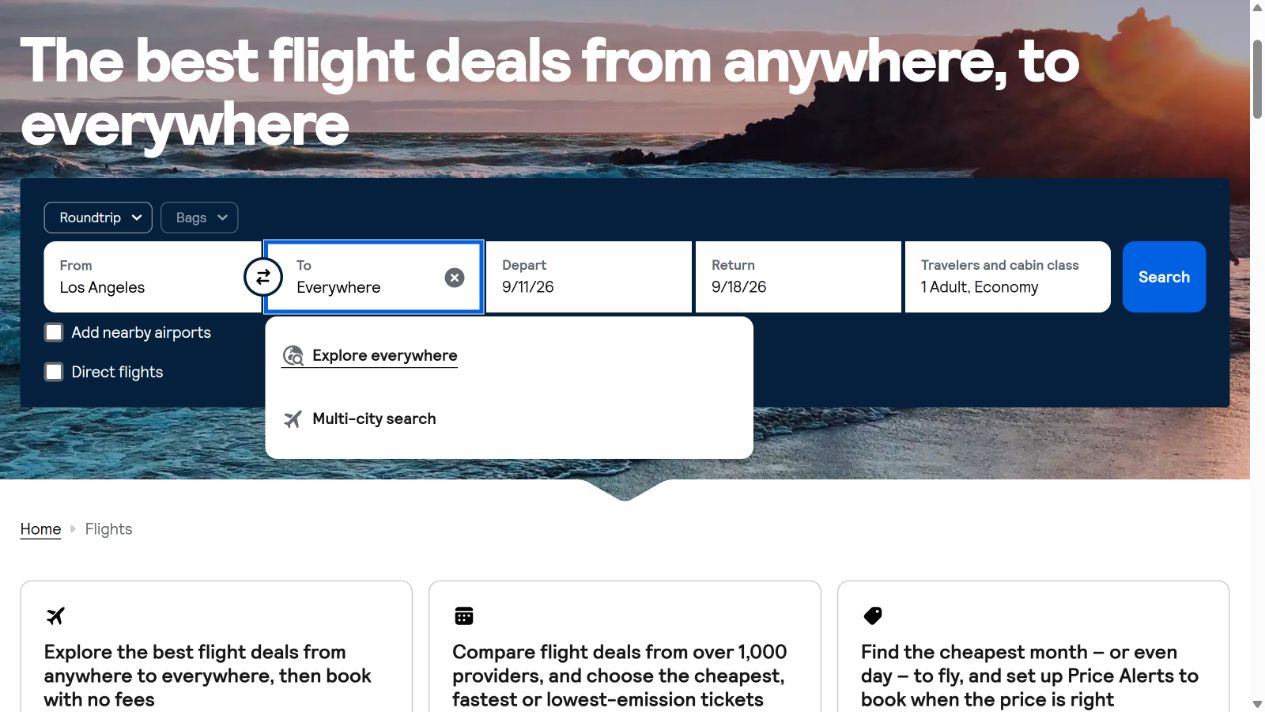
The screenshot proves: Skyscanner puts open-ended destination discovery inside the main flight-search form. It demonstrates the workflow advantage, not a guaranteed fare.
Choose Skyscanner when: destination inspiration matters more than a highly specific itinerary.
Keep Google Flights in the loop when: you have narrowed the trip and want to compare exact operating flights, dates, and airports.
2. Soar: booking-focused Google Flights alternative
Soar is the best second alternative when you have a real trip in mind and want to move from live results toward booking. Its workflow keeps the route, travelers, viable itineraries, and booking action connected.
Some searches also show Soar Atlas, which compares standard fares with qualifying hidden-city tickets. Review the complete ticket and airline rules before you choose one.
Open-ended discovery is not Soar's main advantage because Skyscanner is better for “show me anywhere,” ITA Matrix provides more routing syntax, and Going specializes in passive deal alerts. Soar's advantage is continuity after the trip becomes specific.
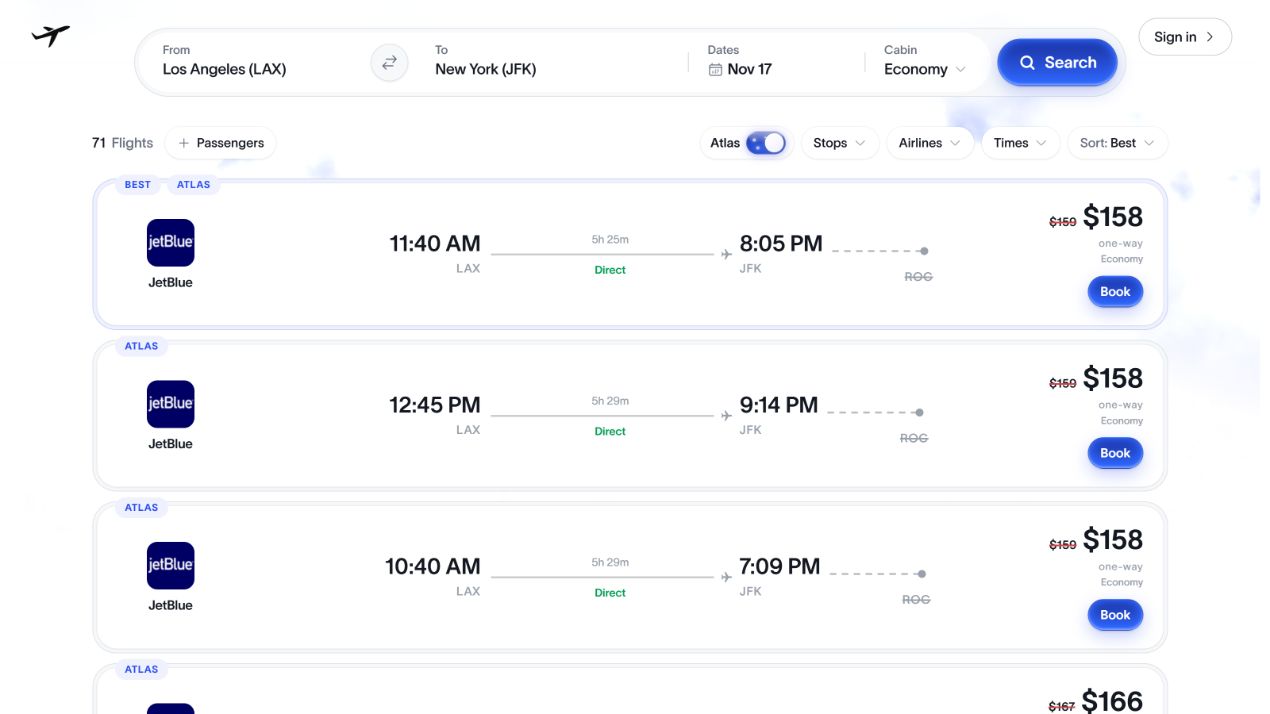
The screenshot proves: Soar returns filterable live results with clear Book actions for a specific route. Prices shown were live during the capture and are not a fare promise.
Choose Soar when: you want to act on a specific trip in a focused flow.
Use both tools when: Google's calendar helps choose the dates but you want a second live search before booking. Our guides explain how Soar searches flights and what Soar does after booking.
3. KAYAK: best alternative to Google Flights for detailed filters
KAYAK is the best alternative when a basic price-and-stops filter is not enough. Its current pricing guide lists controls for airline, price, stops, duration, baggage, flight quality, and booking sites, which makes it useful for isolating a schedule you would genuinely take.
Separate-ticket combinations are KAYAK's main caution because its Hacker Fares use multiple bookings with separate rules and confirmation numbers. KAYAK explains that each ticket must be changed or canceled individually in its official pricing guide.
Choose KAYAK when: you want a dense comparison workspace or have several schedule, airline, and baggage constraints.
Watch the seller when: a result sends you to an airline or agency, because the company taking payment controls the post-booking process.
4. Momondo: best Google Flights alternative for a second metasearch view
Momondo is the best second pass when you want another view of airline and agency offers. Its Price Calendar, Anywhere Search, and Trip Finder cover flexible exploration while its results emphasize cheapest, quickest, and best tradeoffs.
Seller verification is essential because Momondo says in its help center that it is not a travel agency and does not sell tickets. The airline or online travel agency on the payment page owns the transaction and normally becomes the first contact for booking questions.
Choose Momondo when: you want to check whether another metasearch presentation surfaces a useful provider or itinerary.
Watch the final purchase when: support, payment currency, baggage display, or change handling differs between sellers for the same flight.
5. ITA Matrix: advanced Google Flights alternative for complex routing
ITA Matrix is the best specialist alternative for routing and fare research. It supports exact dates, flexible-date calendars, multiple airports, multi-city trips, preferred times, cabin, currency, sales city, and advanced routing controls.
Routing syntax is ITA Matrix's decisive advantage because Google's official Matrix documentation explains how to require or exclude airlines, connections, airports, red-eyes, and overnight stops. A normal consumer interface cannot express many of those constraints.
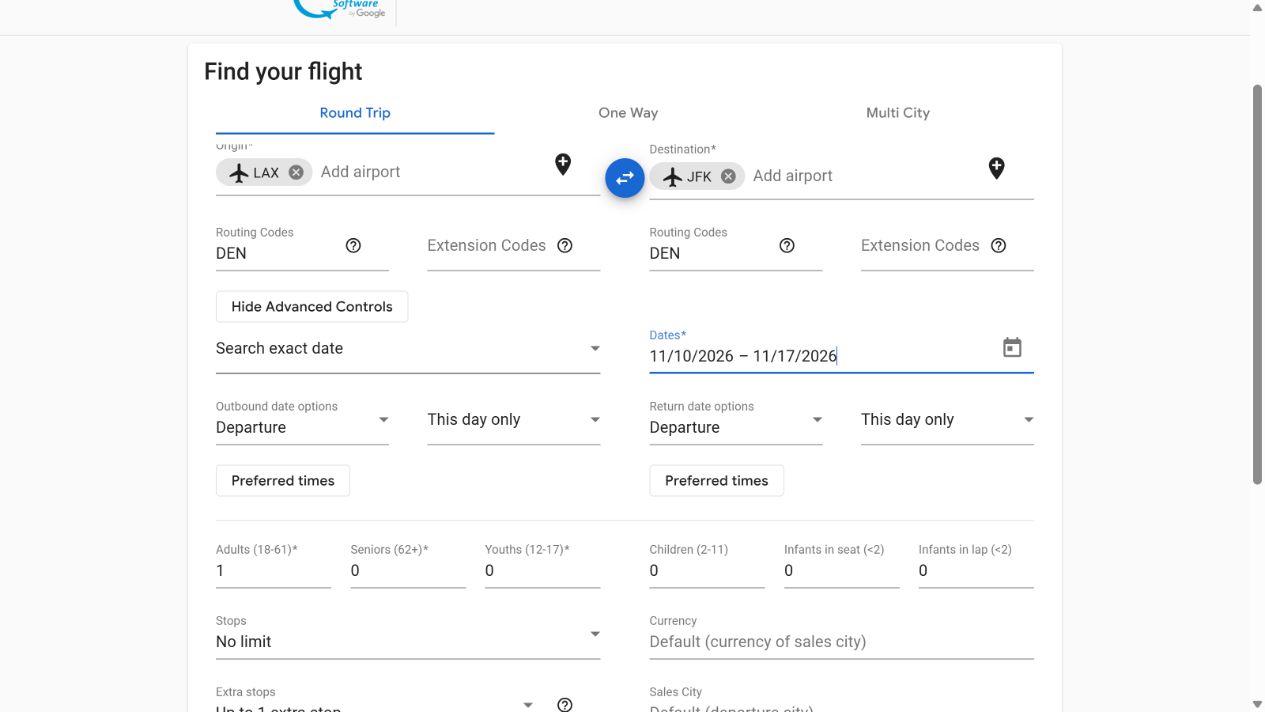
The screenshot proves: ITA Matrix exposes dedicated outbound and return routing-code fields. It shows why the tool is better for itinerary construction than quick checkout.
Direct booking is not available because Matrix is a research tool. Recreate the selected itinerary with an airline or travel agency that can price and issue it.
Choose ITA Matrix when: you need a particular connection, precise routing logic, or a difficult multi-city construction.
Skip ITA Matrix when: you simply want a good nonstop and a fast payment path.
6. Hopper: mobile Google Flights alternative for price guidance
Hopper is the best alternative for travelers who want an app to give them a buy-or-wait opinion. Its mobile workflow centers the prediction and notification instead of requiring repeated manual checks.
The Hopper website is not equivalent to the app because Hopper says web flight booking is available only to select U.S. travelers, while Price Prediction and other products remain app-only. Travelers outside that group should evaluate Hopper as a mobile product.
Price predictions are guidance, not guarantees, because Hopper states that its predictions can be inaccurate. Set your own maximum price and booking deadline before waiting.
Choose Hopper when: a mobile prompt is more useful than repeatedly checking a price graph.
Watch the final total when: optional airline fees, seats, bags, or add-ons appear during checkout.
7. Going: best Google Flights alternative for deal alerts
Going is the best alternative when you want flight deals to come to you. You select U.S. departure airports, Going sends qualifying deal alerts, and you follow its instructions to book with an airline or travel agency.
Exact-trip search is not Going's job because the service says it is not a flight search engine or booking agency. Its value is highest when your destination and dates can follow the deal rather than when one fixed itinerary must be purchased today.
Choose Going when: you want a reason to take a trip and can be flexible about where or when.
Use a live search afterward: confirm that the fare still exists for your dates, party size, cabin, and baggage needs before making nonrefundable plans.
8. Kiwi.com: alternative to Google Flights for self-transfer combinations
Kiwi.com is the best alternative when conventional airline relationships do not produce a workable route. The online travel agency can combine carriers on separate tickets and surface schedules that a through-ticket search may miss.
Self-transfer risk is the main tradeoff because Kiwi.com says travelers may need visas, airport transfers, new check-ins, and baggage collection between independently booked flights. Its official self-transfer guide also explains that airline rebooking obligations differ from those on protected connections.
Choose Kiwi.com when: an unusual combination solves the route and you can assess separate-ticket risk.
Avoid the combination when: a missed connection would jeopardize a cruise, wedding, visa window, or another fixed commitment.
9. Alternative Airlines: Google Flights alternative for payment choice
Alternative Airlines is the best alternative when airline coverage or payment choice is the bottleneck. The agency says it supports more than 600 airlines, 40-plus payment methods, and 160 currencies, although its payment options vary by country and currency.
Financing is not automatically a saving because interest, fees, refund routing, and repayment terms can outweigh a small fare difference. Compare the final amount and support terms before choosing an installment option.
Choose Alternative Airlines when: checkout method, currency, or access to a smaller carrier matters as much as the search interface.
Watch the intermediary tradeoff when: changes, cancellations, or refunds must be handled through the agency instead of the airline.
Google Flights vs. Skyscanner vs. Hopper
Google Flights is the best exact-route baseline, Skyscanner is the best open-ended explorer, and Hopper is the best mobile buy-or-wait guide. The tools overlap, but each gives its clearest answer to a different question.
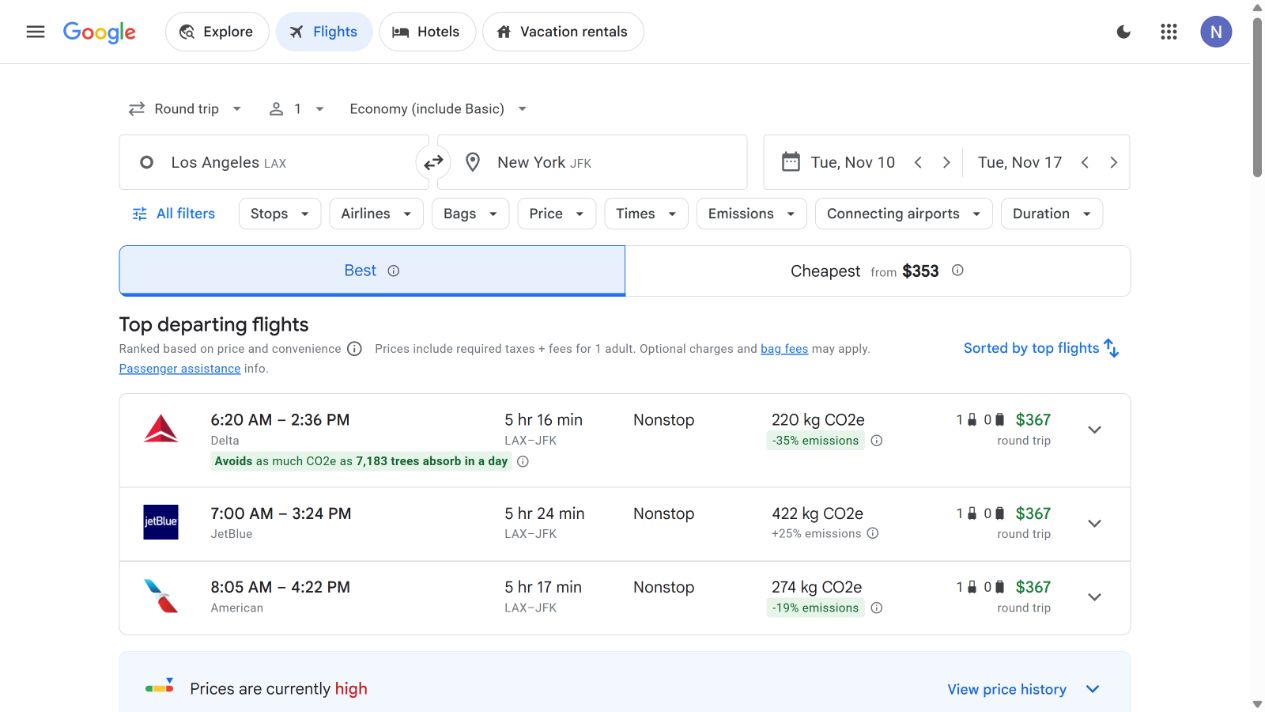
The screenshot proves: Google Flights combines ranked itinerary results with filters for airlines, bags, times, duration, connections, and emissions. It remains a strong control search even when another tool wins a narrower job.
| Your question | Best tool | Why it wins |
|---|---|---|
| 🗓️ Which exact flight works? | Google Flights | Best baseline for dates, airports, schedules, and filters |
| 🌍 Where could I go? | Skyscanner | Best open-ended destination and month discovery |
| ⏳ Should I wait or buy? | Hopper | Best mobile prediction and alert workflow |
Google Flights now also covers some open-ended discovery through its experimental AI-powered Flight Deals. A replacement therefore needs to beat Google on a specific job, and Google's beta still has limits such as no multi-city search and no request for a specific layover.
Different prices do not prove that one tool is consistently cheaper because refresh timing, provider coverage, cached estimates, and booking channels vary. Compare the same operating flights and final seller, not the first headline price on each screen.
Which airlines are not on Google Flights?
No permanent list of airlines outside Google Flights is reliable because airline participation and route coverage change. Google says it works with more than 300 airline, agency, and aggregator partners but does not include every airline or available flight.
The safest way to find an airline missing from your results is to build the carrier list from the route outward. Use the same dates and passengers at every step:
- Check the airports: Open the destination airport's airline or nonstop-destination list.
- List plausible carriers: Note every airline operating the route or serving a useful connecting hub.
- Search airline-direct: Check those carriers' own sites for the exact trip.
- Run a second metasearch: Use Skyscanner, KAYAK, or Momondo to look for another provider view.
- Match the ticket: Compare operating flights, ticket structure, bags, currency, and final total.
This route-first check is more reliable than a static “missing airlines” list because the answer can differ by market, date, and partnership.
What is the best third-party flight site?
Skyscanner is best for flexible discovery, KAYAK is best for detailed filtering, and Momondo is best as a second metasearch check. These sites compare options but often send you elsewhere to pay.
Compare the itinerary and support terms before choosing a third-party seller. Check who handles changes, cancellations, and refunds, then review the full price.
Should you book direct or through a third party?
Book directly with the airline when prices are close and the trip may change. Removing one intermediary usually makes voluntary changes and disruption conversations simpler, although it cannot prevent cancellations or delays.
A reputable third party is worthwhile when it offers a meaningfully lower total, a payment method you need, or an itinerary the airline cannot sell in one checkout. The benefit should be large enough to justify the support path and ticket complexity.
Four answers should be clear before you pay:
- Card charge: Who charges the card?
- Ticket issuer: Who issues each ticket?
- Connection protection: Is every segment on one ticket?
- Post-booking support: Who handles a change or refund?
Save both the seller confirmation and the airline record locator after booking. Then open the trip on the operating airline's site and verify passenger names, seats, and bags.
A five-minute Google Flights cross-check before booking
Use two search tools and the airline site before paying. Match the exact itinerary rather than comparing unrelated headline prices:
- Match the flight: Confirm flight numbers, dates, airports, and operating carriers.
- Price the full party: Search for every traveler because one cheap seat may not price the group.
- Price the real fare: Include carry-on rules, checked bags, seats, and card fees.
- Identify ticket risk: Find every self-transfer, airport change, and overnight connection.
- Match the currency: Compare the final card total, not the search-page headline.
- Name the support owner: Confirm who handles changes, cancellations, and refunds.
Include separate tickets, ground transfers, and seller fees when comparing the total trip cost.
Frequently asked questions
What is the best Google Flights alternative?
Skyscanner is the best Google Flights alternative for flexible destinations, Soar is the second choice for a connected search-to-booking flow, KAYAK is best for detailed filters, ITA Matrix for advanced routing, Hopper for mobile price guidance, and Going for deal alerts. The best overall choice depends on the job Google Flights is not solving for your trip.
Is there a better alternative to Google Flights?
No alternative is better at every task. Google Flights remains a strong exact-route baseline, while specialist tools beat it at open-ended discovery, routing syntax, mobile predictions, deal alerts, unusual ticket combinations, payment choice, or booking continuity.
Is Skyscanner cheaper than Google Flights?
Skyscanner is not consistently cheaper than Google Flights. The sites may surface different providers or refresh at different times, so compare the same flight numbers, fare conditions, bags, currency, and final seller.
Is Hopper better than Google Flights?
Hopper is better when you want a mobile watch-or-buy recommendation, while Google Flights is better for quickly comparing dates, airports, and flight options. Neither tool can guarantee a future fare.
Is ITA Matrix the same as Google Flights?
ITA Matrix is not the same as Google Flights. Matrix is the specialist interface with advanced routing codes and no direct checkout, while Google Flights is the more accessible consumer search experience and usually links to an airline or agency for booking.
Does Google Flights sell the ticket?
Google Flights usually does not sell the ticket. It compares options and typically sends you to an airline or online travel agency, so the company named on the final payment page is the seller.
How we evaluated these Google Flights alternatives
We evaluated each alternative by job, not by one volatile fare. On September 5, 2026, we checked current product interfaces and official documentation against six practical questions:
- Search fit: Is the tool built for exact trips, flexible exploration, or deal discovery?
- Search control: Can it handle flexible dates, nearby airports, preferred airlines, and routing constraints?
- Ticket risk: Does it identify separate-ticket or self-transfer itineraries?
- Booking path: Can you buy there, or does it send you to another company?
- Support owner: Who handles changes, cancellations, and refunds after payment?
- Distinct advantage: What does it do meaningfully better than Google Flights?
One fare screenshot cannot prove that a site is consistently cheaper. Airfare and availability change between searches, and prices are not comparable until the flight numbers, fare conditions, bags, seats, currency, and seller match.
Community reports helped identify recurring search problems, not establish product facts. Recent TravelHacks discussions about broader searches and cross-checking flight sites repeatedly point travelers toward Skyscanner, KAYAK, Momondo, ITA Matrix, and airline-direct verification, so we checked those claims against current interfaces and first-party help pages.
What we verified in our September 2026 test
Four interface checks show why no single Google Flights alternative wins every task. The results below record what was visible during the test, not a permanent promise about inventory or price.
| Test task | What we observed | Best answer for that job |
|---|---|---|
| Exact LAX–JFK round trip, November 10–17 | Google Flights displayed ranked results plus Best/Cheapest views and controls for airlines, bags, times, duration, connections, and emissions | Google Flights remained the strongest baseline |
| Flexible trip from Los Angeles | Skyscanner exposed “Everywhere” directly in the destination field | Skyscanner gave the clearest open-ended starting point |
| LAX–JFK with DEN as a routing constraint | ITA Matrix exposed outbound and return routing-code fields | ITA Matrix gave the most precise routing control |
| One-way LAX–JFK search for November 17 | Soar returned live results with filters, sorting, and visible Book actions | Soar gave the most direct search-to-action path in this test |
The remaining products were verified through their current official search, help, or booking documentation. This split keeps interface observations separate from vendor claims.
Prices, schedules, and airline rules can change. Always review the final itinerary and fare terms before booking.
If our guides have earned a place in your travel research, you can add Soar as a preferred source.